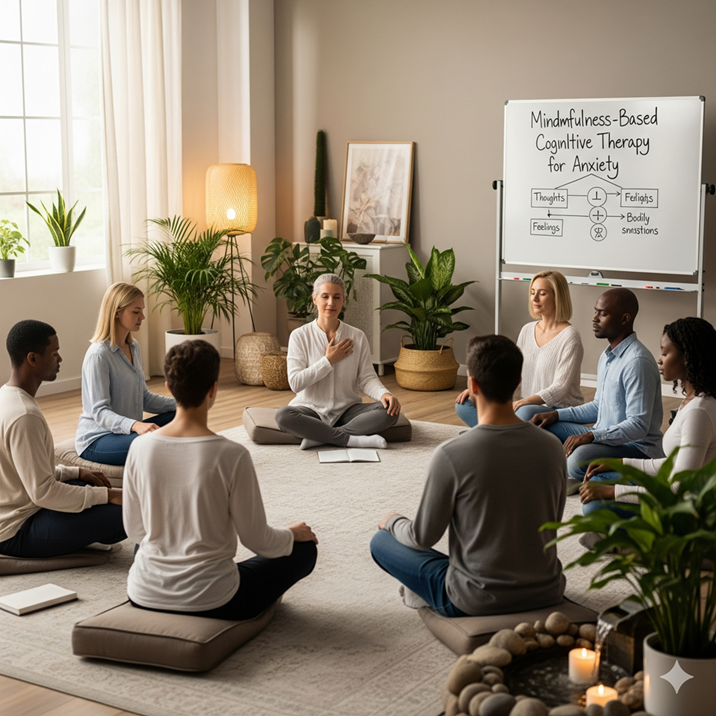
Mindfulness based cognitive therapy for anxiety is crushing traditional talk therapy approaches – and here’s why most people are getting it completely wrong.
You’re lying in bed at 3 AM again. Your mind’s racing through every possible worst-case scenario. The mortgage payment, that weird pain in your chest, whether your boss really meant “good job” or was being sarcastic. Sound familiar?
The Real Problem With Anxiety (That Nobody Talks About)
Here’s what everyone gets wrong about anxiety treatment. Most people think anxiety is the enemy. They’re trying to eliminate it, fight it, or medicate it away. That’s like trying to stop the tide with a bucket.
The actual problem isn’t the anxious thoughts. It’s how we respond to them. When you have an anxious thought, you immediately start thinking about the anxious thought. Then you think about thinking about the anxious thought. Welcome to the anxiety spiral.
What Actually Is MBCT?
Mindfulness Based Cognitive Therapy combines two powerhouse approaches that work better together than apart.
Mindfulness meditation teaches you to observe your thoughts without getting caught up in them. Cognitive behavioural therapy helps you recognise unhelpful thought patterns and change them.
Think of it like this: CBT gives you the map, mindfulness gives you the GPS. One shows you where the mental traps are, the other keeps you aware of where you actually are moment to moment.
How MBCT Actually Works for Anxiety
The Observer Effect
Most people are completely identified with their thoughts. They think “I’m having a panic attack” instead of “I’m noticing panic sensations.” MBCT teaches you to step back and observe what’s happening in your mind like you’re watching Netflix. Interesting, but not necessarily true or important.
Breaking the Rumination Loop
Rumination is anxiety’s best friend. You know that thing where you replay conversations from 2019 and somehow make them worse? MBCT interrupts this process by teaching you to notice when you’ve gone down the rabbit hole. Then you gently bring your attention back to the present moment.
The RAIN Technique
Recognise what’s happening right now. Allow the experience to be there without fighting it. Investigate with kindness – what does this actually feel like in your body? Natural awareness – let it be there without trying to fix it.
This isn’t hippie nonsense. It’s based on decades of neuroscience research.
The Science Behind Why MBCT Works
Your brain has two operating systems. The default mode network (DMN) is constantly running background programmes about the past and future. This is where anxiety lives. The task-positive network focuses on what’s happening right now.
MBCT literally rewires your brain to spend more time in the present-focused network. Studies show 8 weeks of MBCT practice reduces activity in the DMN by up to 60%. That’s like turning down the volume on your anxiety radio station.
Common MBCT Techniques for Anxiety
The Body Scan
Start at the top of your head. Notice any sensations, tensions, or temperature changes. Move slowly down through your entire body. When your mind wanders (it will), gently bring it back.
This isn’t about relaxation. It’s about building your attention muscle.
Mindful Breathing
You’re not trying to change your breathing. You’re using your breath as an anchor for your attention. When you notice your mind has wandered to that email you need to send, come back to the breath. Every time you notice and return, you’re doing it right.
The 5-4-3-2-1 Grounding Technique
5 things you can see 4 things you can touch 3 things you can hear 2 things you can smell 1 thing you can taste
This works because anxiety lives in the future and past. Your senses only exist in the present moment.
What MBCT Isn’t (Common Misconceptions)
It’s Not About Stopping Thoughts
If someone tells you meditation will stop your thoughts, they’re selling you magic beans. The goal is to change your relationship with thoughts, not eliminate them. Think of thoughts like cars on a motorway – you don’t need to get in every one that passes.
It’s Not Instant
This isn’t a quick fix. Most research shows benefits after 8 weeks of consistent practice. 20 minutes a day, most days of the week. Less effective than therapy + medication in the short term, more effective in the long term.
It’s Not Religious or Spiritual (Unless You Want It To Be)
MBCT is completely secular. It’s based on clinical research, not belief systems. You don’t need to chant, burn incense, or believe in anything except the possibility that your mind can change.
Who Benefits Most from MBCT?
People with Recurring Anxiety
If you’ve had multiple episodes of anxiety or depression, MBCT reduces relapse rates by up to 43%. This is massive. Traditional therapy teaches you to challenge anxious thoughts. MBCT teaches you not to get pulled into the argument in the first place.
Those Who’ve Tried Everything Else
If medication and traditional therapy haven’t worked, or you want to reduce dependence on medication, MBCT offers a different approach. It’s not better or worse than other treatments – it’s different.
People Who Want Long-Term Skills
CBT gives you tools to use when you’re struggling. MBCT gives you a way of being that prevents many struggles from starting. It’s the difference between having a good insurance policy and building a stronger house.
Getting Started with MBCT
Finding Qualified Practitioners
Look for therapists trained specifically in MBCT. Not just mindfulness, not just CBT – the combination matters.
Self-Help Resources
The Mindful Way Through Depression by Williams, Teasdale, Segal, and Kabat-Zinn. Includes guided meditations and the complete 8-week programme. Apps like Headspace and Calm are fine for basic mindfulness, but they’re not MBCT.
What to Expect
Week 1-2: This feels weird and your mind is everywhere. Week 3-4: You start noticing patterns in your thinking. Week 5-6: The practices begin feeling more natural. Week 7-8: You can apply the skills in real situations.
The real changes happen in months 3-6 of consistent practice.
The Bottom Line
Mindfulness based cognitive therapy for anxiety isn’t about eliminating difficult emotions or achieving some zen-like state of permanent calm.
It’s about developing a different relationship with your internal experience. Instead of being at the mercy of every anxious thought, you become the observer of your own mind. You learn to respond rather than react. And gradually, anxiety loses its grip on your life.
The research is clear: MBCT works for anxiety when practised consistently over time. But like anything worthwhile, it requires commitment and the willingness to sit with discomfort while you learn.
Most people want a magic pill. This is more like going to the gym for your mind. The results are real, but you have to do the work.
That’s the truth about mindfulness based cognitive therapy for anxiety – it’s simple, evidence-based, and requires zero faith except in your own capacity to change.
No Responses